Artificial Intelligence is evolving faster than most people expected. Every few months, a new AI model appears that can write code, generate designs, summarize documents, automate workflows, and even solve technical problems.
Because of this rapid growth, many people are worried about their careers. Some believe AI will eventually replace programmers, analysts, designers, writers, and even engineers.
But there is one thing that AI still struggles with consistently:
Real problem solving.
In 2026, the biggest difference between average professionals and highly valuable professionals is no longer just technical knowledge. It is the ability to understand problems deeply, think clearly under uncertainty, and make practical decisions in complex situations.
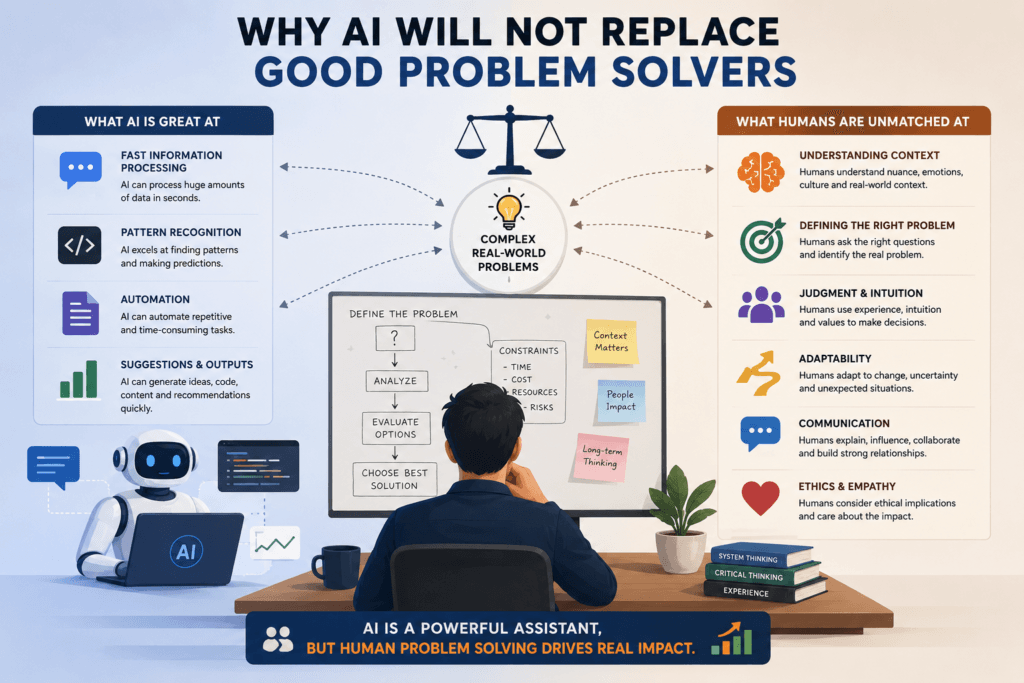
AI can generate answers quickly, but understanding the right problem to solve is still a very human skill.
AI Is Extremely Good at Patterns
Modern AI models are trained on massive amounts of data. They are excellent at:
- recognizing patterns,
- generating responses,
- summarizing information,
- predicting likely outputs,
- and automating repetitive tasks.
This is why AI tools feel incredibly powerful.
For example:
- AI can generate SQL queries,
- write Python scripts,
- create dashboards,
- suggest architectures,
- and even explain technical concepts.
But most real-world problems are not clean textbook questions.
Real business problems are often:
- incomplete,
- messy,
- unclear,
- constantly changing,
- and filled with hidden constraints.
This is where strong problem solvers become valuable.
Most Real Problems Do Not Have Perfect Inputs
One of the biggest misconceptions about AI is that companies operate with perfectly organized systems and clearly defined requirements.
That rarely happens in reality.
In actual projects:
- data is incomplete,
- stakeholders change requirements,
- systems fail unexpectedly,
- APIs behave differently,
- and business teams may not fully understand what they want.
A good problem solver can work through ambiguity.
They ask questions like:
- What is the actual root cause?
- Is this even the correct problem to solve?
- What constraints exist?
- What happens if this solution scales?
- Is there a simpler approach?
AI can help generate possibilities, but humans still need to decide which direction makes sense.
AI Generates Outputs, Humans Define Objectives
One important thing people often overlook is that AI usually works based on instructions.
Someone still needs to:
- define the goal,
- understand the business context,
- identify risks,
- and evaluate whether the solution is useful.
For example, an AI model may generate:
- a recommendation system,
- a dashboard,
- or automation logic.
But a human still needs to determine:
- whether the recommendation is meaningful,
- whether the dashboard solves the actual issue,
- or whether automation creates new operational risks.
This is why structured thinking matters so much.
Good problem solvers do not just chase outputs. They focus on outcomes.
The Hardest Problems Are Usually Not Technical
Many beginners think strong careers are built only on technical skills.
Technical knowledge is important, but in many enterprise environments, the hardest problems are often:
- operational,
- communication-related,
- process-related,
- or business-related.
For example:
- teams may disagree on priorities,
- departments may use inconsistent data,
- systems may lack ownership,
- or workflows may be poorly designed.
In these situations, simply generating more code does not solve the issue.
A good problem solver looks at the bigger picture.
They understand:
- dependencies,
- tradeoffs,
- scalability,
- human behavior,
- and business impact.
This type of thinking becomes extremely valuable in AI-driven industries.
AI Still Struggles With Context
AI models are improving rapidly, but they still face limitations with deep contextual understanding.
They may generate technically correct responses that are completely impractical in real-world situations.
For example:
- an AI-generated solution may ignore cost constraints,
- create security risks,
- increase system complexity,
- or fail under production workloads.
Humans with real implementation experience usually recognize these issues faster.
This is why practical thinking matters much more than simply memorizing tools.
In fact, many companies are now realizing that employees who understand:
- systems,
- workflows,
- debugging,
- operations,
- and business processes
often create far more value than people who only know how to use AI interfaces.
Debugging Is Becoming More Important Than Coding
One major shift happening in 2026 is that AI is reducing the time needed to generate code, but increasing the importance of debugging and validation.
Earlier, engineers spent most of their time writing code manually.
Now AI can generate large portions of code in seconds.
But generated code still needs:
- verification,
- optimization,
- testing,
- security review,
- and performance analysis.
This means the real skill is shifting from:
“Can you write code?”
to:
“Can you identify what is wrong and improve the solution?”
That requires problem-solving ability.
A person who understands systems deeply can usually identify:
- hidden bottlenecks,
- incorrect assumptions,
- inefficient logic,
- or scalability issues
much faster than someone blindly copying AI outputs.
Good Problem Solvers Adapt Faster
Technology changes constantly.
A few years ago, people focused heavily on:
- traditional machine learning,
- then deep learning,
- then cloud engineering,
- then Generative AI,
- and now AI Agents and orchestration systems.
Tools will continue evolving.
But strong problem solvers adapt much faster because they understand principles instead of depending only on specific tools.
For example:
- a person who understands data relationships can learn new databases quickly,
- someone who understands machine learning fundamentals can adapt to new frameworks,
- and someone with structured thinking can work across multiple technologies.
This adaptability creates long-term career stability.
Communication Is a Major Part of Problem Solving
One underrated aspect of problem solving is communication.
Many technically skilled people struggle because they cannot explain:
- the actual issue,
- the tradeoffs,
- the risks,
- or the reasoning behind decisions.
Good problem solvers simplify complexity.
They help teams understand:
- what is happening,
- why it matters,
- and what actions should be taken.
In AI-driven environments, communication becomes even more important because many business leaders still do not fully understand AI systems.
The people who can bridge both worlds:
- technical implementation,
- and business understanding
will become extremely valuable.
Also Read: AI Engineers vs Data Scientists vs ML Engineers in 2026
AI Will Replace Repetitive Thinking Faster Than Creative Thinking
AI performs best when:
- patterns are predictable,
- instructions are clear,
- and tasks are repetitive.
But creative problem solving often requires:
- experimentation,
- intuition,
- tradeoff analysis,
- and unconventional thinking.
For example:
- reducing cloud costs,
- improving user workflows,
- optimizing operations,
- or solving organizational inefficiencies
usually requires deeper thinking than simply generating answers.
The most impactful ideas often come from understanding systems and identifying problems others ignored.
This is why creativity combined with technical understanding remains powerful.
Strong Fundamentals Still Matter
Many people entering AI focus only on tools and prompting.
But strong fundamentals still create the biggest long-term advantage.
Skills like:
- SQL,
- data understanding,
- debugging,
- APIs,
- machine learning basics,
- communication,
- and structured thinking
help people solve problems more effectively.
A person who understands how systems work internally can use AI tools much more efficiently than someone who depends entirely on generated outputs.
In many ways, AI is amplifying human capability rather than fully replacing it.
Final Thoughts
AI will continue transforming industries, workflows, and job roles. It will automate many repetitive tasks and significantly improve productivity.
But good problem solvers will remain valuable because real-world problems are rarely simple.
Companies still need people who can:
- think critically,
- understand ambiguity,
- evaluate tradeoffs,
- debug failures,
- communicate clearly,
- and make practical decisions.
AI can generate solutions quickly, but humans still define goals, understand context, and determine what truly creates value.
In 2026, the professionals who succeed will not necessarily be the ones using the most AI tools.
They will be the people who combine:
- strong fundamentals,
- practical thinking,
- adaptability,
- and problem-solving ability.
Because while AI can automate tasks, good problem solving is still deeply human.