
The AI industry has changed rapidly over the last few years. Earlier, companies mostly hired Data Scientists for analytics and Machine Learning Engineers for deploying models. But with the rise of Generative AI, AI Agents, LLMs, automation systems, and enterprise AI platforms, the boundaries between these roles are slowly changing.
Today, many beginners entering AI feel confused because job descriptions often overlap. One company asks for a Data Scientist with LLM experience, another asks for an AI Engineer with MLOps knowledge, while some companies expect ML Engineers to handle cloud deployment, APIs, monitoring, and even prompting.
This has created a common question in 2026:
What is the actual difference between an AI Engineer, a Data Scientist, and an ML Engineer?
The answer is not just about tools. The real difference comes from the type of problems they solve, how they think, and what companies expect them to deliver.
The Industry Is Becoming More Practical
One major shift happening in 2026 is that companies are becoming more practical while hiring.
A few years ago, many organizations focused heavily on:
- certificates,
- theoretical knowledge,
- Kaggle scores,
- and model accuracy alone.
Now companies care much more about:
- solving business problems,
- production deployment,
- automation,
- scalability,
- reliability,
- and cost optimization.
This is one reason why AI Engineer roles are growing rapidly.
Businesses no longer want only dashboards or research experiments. They want AI systems that can:
- automate tasks,
- integrate with enterprise tools,
- analyze data,
- generate outputs,
- and improve operational efficiency.
Because of this, each role is evolving differently.
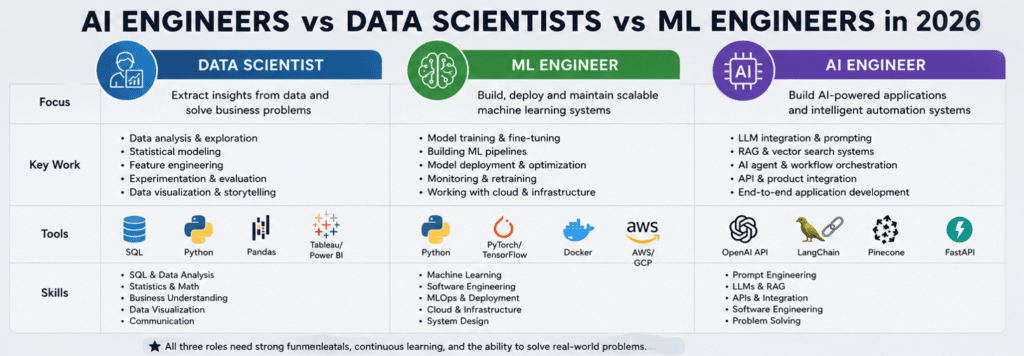
Who Are Data Scientists in 2026?
Data Scientists are still extremely important, but their role is changing.
Earlier, Data Scientists spent a large amount of time building prediction models manually. But today, many AutoML tools and AI platforms can already automate parts of model building.
Because of this, the strongest Data Scientists in 2026 are the ones who deeply understand:
- business problems,
- data patterns,
- statistics,
- experimentation,
- and analytical thinking.
A Data Scientist is usually focused on answering questions like:
- Why are sales dropping?
- Which customers are likely to churn?
- What factors affect revenue?
- Which products perform better?
- How can predictions improve business decisions?
Their work often involves:
- SQL queries,
- data analysis,
- feature engineering,
- visualization,
- experimentation,
- forecasting,
- and prediction models.
One thing many beginners underestimate is how important SQL still is for Data Scientists.
Even in modern AI systems, data remains the foundation. A person who understands:
- joins,
- aggregations,
- filtering,
- data relationships,
- and business logic
often becomes much more effective than someone who only knows AI tools.
In real enterprise environments, poor data quality causes more issues than poor models.
This is why strong Data Scientists spend significant time understanding data itself.
Skills That Matter for Data Scientists in 2026
The most valuable Data Scientists are focusing on:
- SQL and data analysis
- statistics and probability
- experimentation
- storytelling with data
- feature engineering
- business understanding
- Python and analytics libraries
- AI-assisted analytics workflows
Companies are also expecting Data Scientists to become more comfortable with AI-powered tools, but fundamentals still matter far more than simply using ChatGPT.
Who Are ML Engineers in 2026?
Machine Learning Engineers focus more on building reliable machine learning systems.
A Data Scientist may create a prediction model, but an ML Engineer focuses on making that model scalable, deployable, efficient, and production-ready.
This role has become much more important because modern AI systems are no longer small experiments running on local machines. Companies now deal with:
- massive datasets,
- distributed systems,
- APIs,
- cloud infrastructure,
- inference optimization,
- monitoring,
- and retraining pipelines.
ML Engineers are responsible for ensuring models continue working reliably in real-world environments.
For example, an ML Engineer may work on:
- deploying recommendation systems,
- optimizing inference speed,
- building retraining pipelines,
- monitoring model drift,
- managing GPU workloads,
- or integrating AI models into applications.
Unlike pure research roles, ML Engineering is highly implementation-focused.
Fine-Tuning and Real-World Experience
In 2026, companies increasingly value engineers who have practical experience with:
- fine-tuning models,
- inference optimization,
- model retraining,
- embeddings,
- vector databases,
- and LLM pipelines.
Fine-tuning gives engineers real exposure to how AI systems actually behave.
Many people use pretrained models through APIs, but working on fine-tuning teaches important concepts like:
- tokenization,
- hyperparameters,
- training limitations,
- dataset quality,
- overfitting,
- latency,
- and evaluation.
This practical understanding becomes extremely valuable in enterprise environments.
Skills That Matter for ML Engineers in 2026
The strongest ML Engineers usually have:
- strong Python skills
- model deployment knowledge
- cloud understanding
- Docker and APIs
- MLOps basics
- distributed systems knowledge
- GPU optimization awareness
- monitoring and retraining experience
Most importantly, they understand that building AI is not only about training models. It is also about maintaining systems over time.
Who Are AI Engineers in 2026?
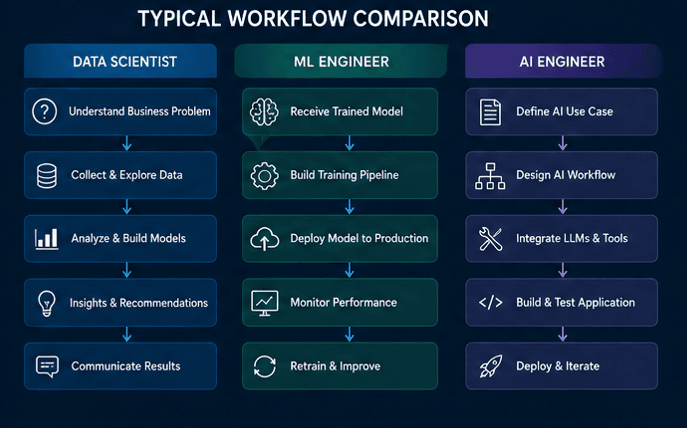
AI Engineers are becoming one of the most in-demand roles in the industry.
This role became popular mainly because of:
- Generative AI,
- LLMs,
- AI Agents,
- automation systems,
- and enterprise AI integration.
Unlike traditional ML Engineers who mainly focus on ML pipelines and deployment, AI Engineers often focus on building end-to-end AI-powered applications.
They combine:
- software engineering,
- AI workflows,
- APIs,
- prompting,
- orchestration,
- and business automation.
An AI Engineer may work on:
- AI copilots,
- enterprise chat systems,
- document intelligence,
- RAG pipelines,
- multi-agent systems,
- AI search,
- workflow automation,
- or AI-powered analytics tools.
This role is becoming highly practical because companies want solutions, not just models.
Prompting Is Not Enough
One misconception many beginners have is that AI Engineering is only about prompt engineering.
Prompting is important, but companies expect much more.
Strong AI Engineers usually understand:
- APIs,
- Python,
- databases,
- embeddings,
- retrieval systems,
- context management,
- orchestration,
- and model limitations.
Many AI projects fail not because prompts are bad, but because:
- data pipelines are weak,
- context is incomplete,
- APIs fail,
- latency increases,
- hallucinations appear,
- or systems become too expensive to scale.
This is why practical engineering knowledge matters heavily in AI roles now.
AI Engineers Need Strong Fundamentals Too
Even though AI Engineers work heavily with LLMs and Generative AI systems, fundamentals still matter.
Understanding:
- how predictions work,
- how models learn,
- how training happens,
- and why outputs fail
helps engineers debug systems much more effectively.
The best AI Engineers are usually not the people using the most tools. They are the people who understand systems deeply.
Skills That Matter for AI Engineers in 2026
Important skills include:
- Python
- APIs
- SQL
- prompting
- vector databases
- RAG pipelines
- embeddings
- cloud basics
- orchestration frameworks
- debugging
- communication
Communication is becoming especially important because AI Engineers often work closely with business teams.
Which Role Is Better in 2026?
This is one of the most common questions, but there is no universal answer.
Each role solves different problems.
Data Scientists
are stronger in:
- analysis,
- experimentation,
- prediction,
- and business insights.
ML Engineers
are stronger in:
- deployment,
- scalability,
- optimization,
- and production systems.
AI Engineers
are stronger in:
- AI-powered applications,
- automation,
- orchestration,
- and integrating AI into workflows.
In reality, many modern jobs overlap between these areas.
A single person may sometimes:
- analyze data,
- build prompts,
- deploy APIs,
- and monitor AI systems.
This is why adaptability is becoming one of the most valuable skills in the industry.
What Skills Actually Create Long-Term Growth?
The AI industry changes extremely fast.
Tools that are trending today may disappear in a few years.
But some skills remain valuable regardless of technology changes.
These include:
- SQL
- problem solving
- structured thinking
- debugging
- communication
- data understanding
- machine learning fundamentals
- system design
- practical implementation
People who focus only on shortcuts or AI tools often struggle whenever technology evolves.
On the other hand, people with strong fundamentals adapt much faster because they understand how systems work underneath the surface.
Final Thoughts
The difference between AI Engineers, Data Scientists, and ML Engineers is becoming less about titles and more about responsibilities.
Companies in 2026 are not simply looking for people who can use AI tools. They are looking for people who can:
- solve real problems,
- work with data,
- understand systems,
- optimize workflows,
- and build reliable solutions.
Data Scientists focus more on extracting insights and predictions from data.
ML Engineers focus more on deploying and maintaining machine learning systems at scale.
AI Engineers focus more on building intelligent applications powered by modern AI systems.
But regardless of the role, one thing is becoming very clear in 2026:
Strong fundamentals matter more than hype.
People who understand:
- SQL,
- data,
- machine learning basics,
- prompting,
- system thinking,
- and practical implementation
will continue to grow even as tools and technologies keep changing.