
The AI industry is moving very fast. Every week there is a new model, a new framework, or a new AI tool trending on social media. Because of this, many people think learning AI is simply about using ChatGPT, generating prompts, or building quick demos.
But the reality inside companies is very different.
Most companies are no longer looking for people who can only “use AI tools.” They are looking for people who understand how AI actually works, how data flows, how predictions are generated, and how systems behave in real-world environments.
In 2026, the biggest difference between an average AI professional and a valuable AI engineer is not the number of tools they know. It is the strength of their fundamentals.
SQL Is Still One of the Most Important Skills
A surprising number of beginners ignore SQL because they think AI will replace database work. But in reality, almost every AI system depends heavily on data.
If the data itself is poor, incomplete, duplicated, or incorrect, even the best AI model will fail.
Most enterprise AI projects spend more time:
- understanding data,
- cleaning data,
- validating outputs,
- and connecting systems
than actually training models.
This is why SQL is still extremely important.
A person who understands:
- joins,
- aggregations,
- filtering,
- window functions,
- data relationships,
- and query optimization
will often solve problems much faster than someone who only knows prompting.
Even modern AI workflows rely heavily on structured data pipelines. Whether you are building dashboards, AI agents, recommendation systems, or prediction models, SQL becomes part of daily work.
Don’t Depend Completely on AI Tools
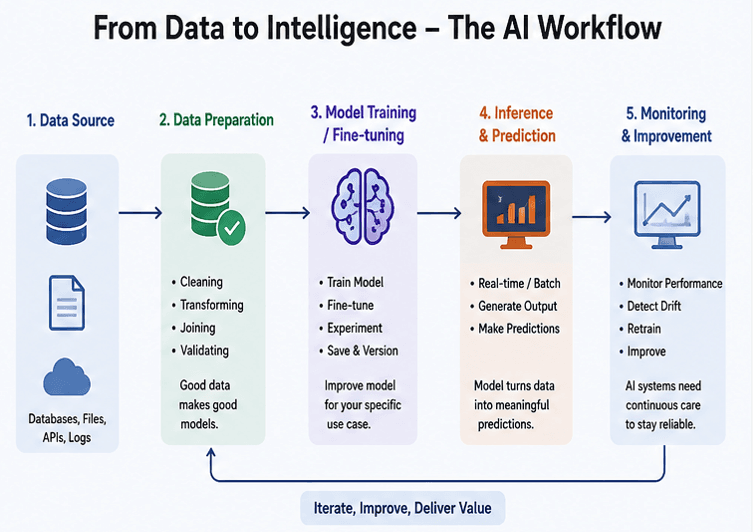
Many people are becoming too dependent on AI-generated code and AI-generated answers.
The problem starts when something breaks.
If the model gives incorrect logic, inefficient code, or wrong predictions, you still need enough knowledge to identify the mistake.
This is why understanding the basics matters.
You should know:
- how machine learning models work,
- how predictions are generated,
- what training data means,
- why overfitting happens,
- what features are,
- and how evaluation works.
You do not need to become a research scientist immediately, but without understanding the foundations, your growth becomes limited.
AI tools can improve productivity, but they should not replace your understanding.
Prompting Is Important, But Basics Matter More
Prompt engineering became very popular because people realized better prompts can improve AI responses significantly.
But good prompting is not just about writing long instructions.
The real skill is understanding:
- context,
- clarity,
- examples,
- output structure,
- and limitations of models.
A person with strong fundamentals usually writes better prompts naturally because they understand the problem deeply.
In many cases, simple and clear prompts work better than extremely complicated prompts.
Instead of memorizing “100 prompt tricks,” focus more on:
- problem solving,
- communication,
- structured thinking,
- and understanding model behavior.
Those skills stay useful even when tools change.
Understanding AI and ML Fundamentals Creates Long-Term Growth
One thing many beginners underestimate is how important machine learning basics are for long-term career growth.
Even if you mainly work with LLMs or Generative AI, understanding traditional ML concepts still helps a lot.
Learn concepts like:
- regression,
- classification,
- clustering,
- training vs testing,
- feature engineering,
- embeddings,
- probability,
- and evaluation metrics.
These concepts build your thinking process.
When you understand how prediction systems work internally, debugging becomes easier.
You also become better at:
- selecting models,
- improving outputs,
- reducing hallucinations,
- and optimizing AI systems.
Fine-Tuning Models Gives Real Experience
A lot of people use pretrained models but never try training or fine-tuning them.
Fine-tuning is one of the best ways to understand how AI systems behave in practical environments.
When you fine-tune models, you start learning:
- data preparation,
- tokenization,
- hyperparameters,
- training costs,
- inference speed,
- and retraining strategies.
You also understand an important reality:
building AI is not just about generating outputs. It is about maintaining quality over time.
In production systems, models need:
- retraining,
- monitoring,
- validation,
- and continuous improvement.
This real-world exposure teaches far more than simply running prompts in a chat interface.
Communication Is Becoming a Major Skill
One underrated skill in AI roles is communication.
A lot of technically strong people struggle because they cannot explain:
- what the model is doing,
- why predictions failed,
- what limitations exist,
- or what business impact the system creates.
Companies now want people who can bridge both sides:
- technical implementation,
- and business understanding.
Sometimes the most valuable AI engineer is not the person who built the biggest model, but the person who clearly solved a business problem.
AI Roles Are Becoming More Practical
A few years ago, many people focused mainly on certificates and theoretical learning.
But companies now care much more about:
- practical implementation,
- debugging ability,
- system thinking,
- optimization,
- and real-world projects.
Even small projects can become powerful learning experiences if you truly understand them.
For example:
- building a recommendation system,
- training a small classification model,
- creating a local RAG pipeline,
- or fine-tuning a lightweight model
can teach more than watching endless tutorials.
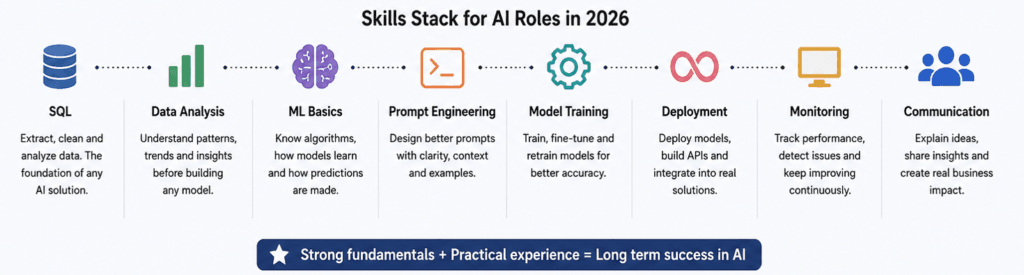
Final Thoughts
The AI industry will continue changing rapidly, and tools will keep evolving.
But strong fundamentals will always stay valuable.
People who focus only on shortcuts may struggle whenever technology changes. On the other hand, people who build a strong base in:
- SQL,
- data understanding,
- machine learning fundamentals,
- prompting,
- model behavior,
- and practical implementation
will adapt much faster.
The future of AI careers is not about knowing every tool. It is about understanding how systems work underneath the surface.
That understanding is what creates long-term growth in AI.

